
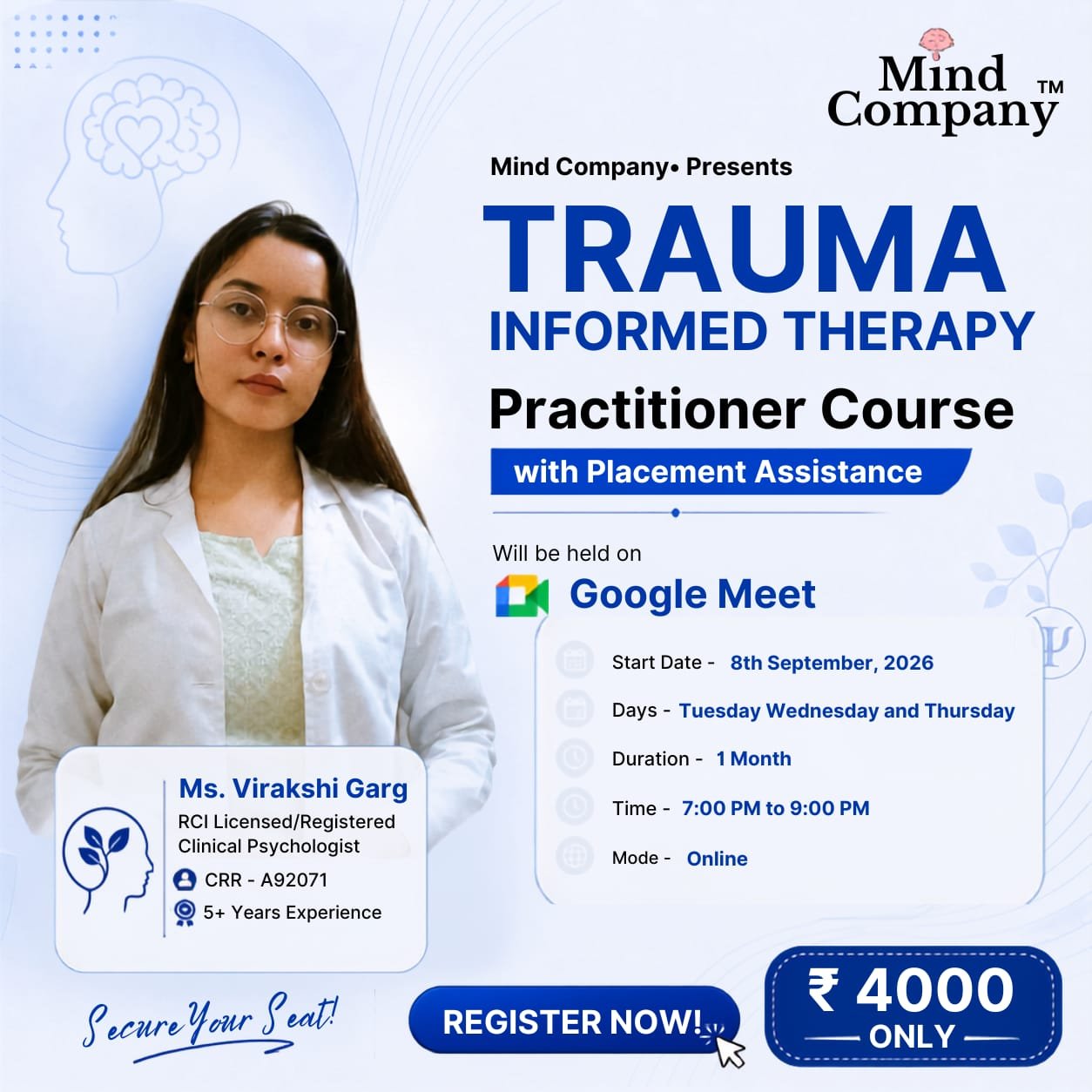
Trauma Informed Therapy Practitioner Course with Placement Assistance – 1 Month
Classes – Tuesday’s, Wednesday’s and Thursday’s
Time – 7:00 – 9:00 PM
Stating Date – 8 September 2026
There will be a real Client/Patient interaction for real practical Exposure
(Attention – The client is willing to volunteer and knows that he/she will be a part of training)
There will be dedicated classes for roleplays
Attention – Lifetime Recording will be provided of all the classes
Facilitator’s Profile – Virakshi Garg | LinkedIn
1-Month Trauma-Informed Therapy Practitioner Course
Course Overview
This practitioner course provides a structured understanding of trauma, complex trauma, trauma-related symptoms, nervous system responses, trauma-informed practice, and therapeutic approaches for working with individuals who have experienced trauma.
The course combines theoretical understanding with practical skills, case conceptualization, therapeutic interventions, role plays, and real-life case discussions to help learners develop a trauma-informed approach to clinical practice.
Module 1: Understanding Trauma
- Introduction to Trauma
- Understanding the Meaning and Definition of Trauma
- Widening the Definition of Trauma
- Simple Trauma vs Complex Trauma
- Types of Complex Trauma
- Understanding PTSD
- Understanding Complex PTSD (cPTSD)
- PTSD vs cPTSD
- Impact of Complex Trauma
- Learned Helplessness
- Etiology of Trauma
- Trauma Bonding and Trauma Bond Archetypes
Module 2: Trauma, Self and Relationships
- Impact of cPTSD on Sense of Self
- Impact of cPTSD on Relationships
- Learned Helplessness
- Understanding Trauma Bonds
- Trauma Bond Archetypes
- Attachment and Trauma
- Betrayal Trauma
- Attachment to the Perpetrator
Module 3: Trauma, Body and Nervous System
- Trauma and Physical Health
- Trauma and the Nervous System
- Resolved vs Unresolved Stress Responses
- Understanding the Vagus Nerve
- Social Engagement System
- Tiered Response to Threat
- Adaptive Survival Strategies
- Neuroplasticity
- Conditioned Immobilization
- Dissociation
- Interpersonal Neurobiology
- Co-regulation
- Signs of a Regulated Nervous System
- Trauma and the Gut
- Understanding the Window of Tolerance
Module 4: Trauma-Informed Practice and Assessment
- Meaning and Foundations of Trauma-Informed Practice
- Foundation of Safety
- Trauma-Informed Case Conceptualization
- Understanding Symptoms in Context
- Barriers to Case Conceptualization
- Clinical Interview Skills
- Trauma History Taking
- History Taking Tools
- Assessing Complex Trauma Presentations
- Understanding Betrayal Trauma
- Working with Shame
- Building Affect and Sensation Tolerance
- How to Communicate with People Who Have Experienced Trauma
- Trauma-Informed Language
Module 5: Working with Trauma
- Understanding Trauma Processing
- What Does It Mean to Process Trauma?
- Recovery from Trauma
- Developing Calm and Focus
- Maintaining Regulation in Response to Trauma Reminders
- Reconnecting with the Present
- Working with Traumatic Memories
- Interventions for Trauma
- Top-Down and Bottom-Up Approaches
- Emotion Regulation
- Strengthening the Capacity of the Prefrontal Cortex
- Recalibrating the Autonomic Nervous System
- Window of Tolerance
Module 6: Parts Work and Trauma Therapy Approaches
- Unified Approach to Parts Work
- Internal Family Systems (IFS)
- Ego States in Therapy
- Structural Dissociation Model
- Polyvagal Theory
- Ego Work
- Reparenting
- Four Pillars of Reparenting
- Mindfulness and Meditation
- Yoga, Breath and Movement-Based Practices
- Touch and Body-Based Approaches
- Sleep and Play as Part of Recovery
- Polyvagal Exercises for Safety
Module 7: Moving Clients Forward
- Compassionate Therapeutic Approach
- Understanding Traumatic Memories
- Predictive Processing
- Reprocessing, Exposure and Desensitization
- Traumatic Memory Reprocessing in cPTSD
- Healthy Coping Strategies
- Developing Emotional Regulation Skills
- Building Capacity for Present-Moment Engagement
Module 8: EMDR and Trauma Memory Work
- Introduction to EMDR
- EMDR in Trauma Work
- Traumatic Memory Reprocessing
- Understanding the Role of EMDR in Trauma Recovery
- Considerations for Working with Complex Trauma
Module 9: Resilience and Post-Traumatic Growth
- Understanding Resilience
- Post-Traumatic Growth
- Vulnerability as a Part of the Healing Process
- Pillars of Resilience
- Resilience Practices
- Emotional Supplements
- Factors Associated with Post-Traumatic Growth
- Developing Coherence
- Healthy Coping and Recovery Strategies
Module 10: Practical Application
- Real-Life Case Discussions
- Clinical Case Conceptualization
- Role Plays
- Practical Activities
- Application of Trauma-Informed Techniques
- Therapeutic Communication Practice
- Understanding and Responding to Trauma Presentations
- Implementing Trauma-Informed Approaches in Clinical Settings
Module 11: Integration and Clinical Practice
- Integrating Trauma-Informed Concepts
- Connecting Trauma, Body, Nervous System and Behaviour
- Integrating Case Conceptualization with Intervention
- Selecting Appropriate Trauma-Informed Strategies
- Maintaining Safety and Regulation During Trauma Work
- Developing a Compassionate and Trauma-Informed Therapeutic Approach
Module 12: Doubt Clearing and Course Integration
- Doubt Clearing Session
- Revision of Key Concepts
- Discussion of Clinical Cases
- Clarification of Practical Applications
- Integration of Course Learning
- Questions and Discussion
Class 13: Placement Assistance & Career Preparation
This final session focuses on helping learners professionally present their skills and prepare for career opportunities in the mental health and psychology field.
Topics Covered
- Resume Building for Psychology Professionals
- Creating a Professional and Industry-Relevant Resume
- How to Present Clinical and Practical Experience
- LinkedIn Profile Optimization
- Building a Professional LinkedIn Presence
- How to Highlight Skills, Certifications and Experience
- Personal Branding for Psychology Professionals
- Interview Preparation
- Common Interview Questions
- How to Answer Interview Questions Effectively
- Communication and Professional Presentation Skills
- Mock Interview Preparation
- Job Search and Application Guidance
- Career Opportunities in the Mental Health and Psychology Field
Placement Assistance Session
The session will be conducted by Mr. Sajal Sharma, Founder, Mind Company, with practical guidance on resume development, LinkedIn optimization and interview preparation to help learners become more confident and career-ready.
Practical Learning Components
Throughout the course, learners will engage in:
- Case Discussions
- Role Plays
- Clinical Interview Practice
- Case Conceptualization Exercises
- Trauma-Informed Communication Practice
- Practical Application of Therapeutic Techniques
- Nervous System Regulation Exercises
- Parts Work Exercises
- Resilience-Building Practices
- Clinical Scenario-Based Activities
Key Areas Covered
Trauma and Complex Trauma | PTSD and cPTSD | Trauma Bonds | Attachment and Betrayal Trauma | Trauma and the Nervous System | Polyvagal Theory | Dissociation | Interpersonal Neurobiology | Window of Tolerance | Trauma-Informed Practice | Case Conceptualization | Trauma Processing | Parts Work | IFS | Ego States | Structural Dissociation | Reparenting | EMDR | Resilience | Post-Traumatic Growth | Clinical Case Discussions
Course Outcome
By the end of the course, learners will have a structured understanding of trauma and complex trauma and will be introduced to trauma-informed assessment, case conceptualization, therapeutic communication, regulation strategies, trauma-processing approaches, parts work, resilience-building and practical application in clinical settings.
₹6,999.00 Original price was: ₹6,999.00.₹4,000.00Current price is: ₹4,000.00.